Name the measure before choosing a formula
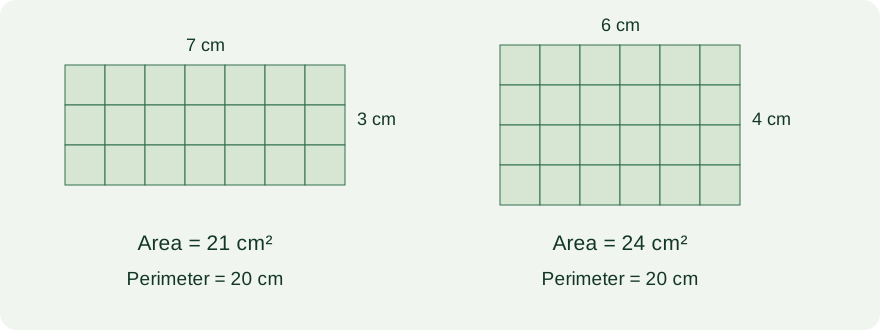
Imagine a rectangular noticeboard that is 7 cm long and 3 cm wide. Covering its face with square pieces asks about area. Running a strip around all four edges asks about perimeter. Both start from the same side lengths, but they count different things. Explain the task before choosing multiplication or addition.
| Measure | Calculation for 7 cm by 3 cm | Unit |
|---|---|---|
| Area | 7 × 3 = 21 | cm²: square centimetres covering the inside |
| Perimeter | 7 + 3 + 7 + 3 = 20 | cm: length around the boundary |
The area formula length × width follows from rows of unit squares: three rows of seven squares make 21 square centimetres. The perimeter formula 2 × (length + width) counts two long sides and two short sides. Adding just length and width counts only half of the boundary.
Same perimeter, different area
Keep the perimeter at 20 cm and use positive whole-number side lengths. Since 2 × (length + width) = 20, the length and width must add to 10. Listing those pairs gives a small investigation that a single formula exercise cannot show.
| Side lengths in cm | Perimeter in cm | Area in cm² |
|---|---|---|
| 1 and 9 | 20 | 9 |
| 2 and 8 | 20 | 16 |
| 3 and 7 | 20 | 21 |
| 4 and 6 | 20 | 24 |
| 5 and 5 | 20 | 25 |
All five boundaries have the same length, but the surfaces do not have the same area. In this whole-number list, the square has the largest area. Turning a 7-by-3 rectangle into a 3-by-7 rectangle does not create a new pair of measurements: orientation changes, while area and perimeter stay the same.
Same area, different perimeter
Now keep the area at 24 cm². The possible whole-number pairs are factors of 24. This reverses the question: products are fixed while sums change.
| Side lengths in cm | Area in cm² | Perimeter in cm |
|---|---|---|
| 1 and 24 | 24 | 50 |
| 2 and 12 | 24 | 28 |
| 3 and 8 | 24 | 22 |
| 4 and 6 | 24 | 20 |
These examples also show why “the larger area always has the larger perimeter” is not a dependable rule. A 1-by-24 rectangle has area 24 cm² and perimeter 50 cm. A 5-by-5 square has a larger area, 25 cm², but a smaller perimeter, 20 cm.
Factor pairsUse factor pairs to list whole-number rectangles with a fixed area.Check what the question is asking
- 1
Calculate both measures
For an 8 cm by 2 cm rectangle, area = 16 cm² and perimeter = 20 cm.
- 2
Compare a second rectangle
For a 6 cm by 4 cm rectangle, area = 24 cm² and perimeter = 20 cm. They share a perimeter, not an area.
- 3
Find a missing side
A rectangle has perimeter 18 cm and one side 5 cm. Half the perimeter is 9 cm, so the other side is 9 − 5 = 4 cm. Its area is 20 cm².
Practice the units as well as the numbers
For every answer, ask whether it describes a line or a surface. An answer of 21 cm for the noticeboard area has the right number with the wrong unit. Use squared units for area and ordinary length units for perimeter. If the side lengths use different units, convert them to the same unit before calculating.
Rectangle area and perimeterGenerate labelled rectangle diagrams and matching area/perimeter answers. Adjust the displayed side-length controls for further practice.Multiplication arraysReturn to rows and columns when the area product needs a concrete explanation.