Three rows of four counters are enough to start a useful multiplication discussion. Ask what the rows, columns and total represent, then turn the array around. Keep those same numbers as you move from the drawing to multiplication and division facts.
Choose one family first
Draw three rows with four counters in each. Ask how many rows there are, how many counters are in each row and how many there are altogether. Using rows first, write 3 × 4 = 12. Say “three rows of four” so the connection between the picture and equation is clear.
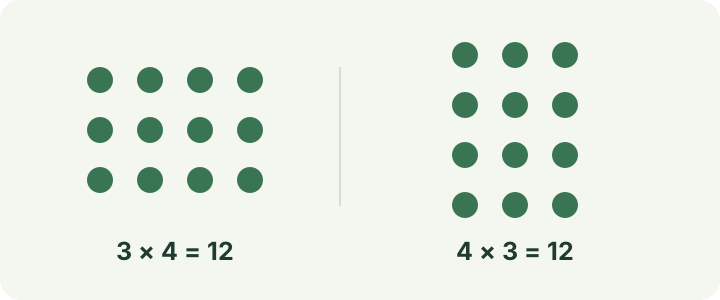
Turn the arrangement so it has four rows of three. Count the same twelve counters and write 4 × 3 = 12. The change of orientation offers a concrete check that these two products are equal. You can then cover the equation and ask which numbers belong in it without making the learner recount every counter.
Multiplication arraysUse an array worksheet to connect groups, rows and equations.Make a short session plan
| Stage | Original task | What to look for |
|---|---|---|
| Draw and describe | Draw 3 rows of 4; write 3 × 4 = 12. | The explanation identifies rows, items per row and total. |
| Change the view | Draw 4 rows of 3; write 4 × 3 = 12. | The total remains 12 although the arrangement changes. |
| Recall the facts | Answer 3 × 4 and 4 × 3 without the drawing. | The learner can reconnect an answer to the array if needed. |
| Use an inverse relationship | Answer 12 ÷ 3 and 12 ÷ 4. | Equal groups are described consistently with the question. |
Connect the two division facts
Use 12 ÷ 3 = 4 to describe sharing twelve counters equally among three rows: each row has four. Use 12 ÷ 4 = 3 to describe arranging twelve counters in rows of four: there are three rows. Say which quantity is missing in each question. The equations belong to the same number family, but their stories ask for different things.
Division factsPrepare a separate division-fact sheet when the equal-group interpretation is clear.Select matching practice deliberately
For more practice, open Multiplication arrays and Multiplication facts. Set a suitable range and look for facts you want to connect. The sheets are generated separately, so their question lists will not automatically match. You can also draw the small set in this activity by hand.
Multiplication factsAdd a short written fact set after the matching array discussion.For a second family, use 4, 6 and 24: 4 × 6 = 24, 6 × 4 = 24, 24 ÷ 4 = 6 and 24 ÷ 6 = 4. Keep this family separate while first discussing it. Mixing the two families later gives you a chance to ask which drawing would fit each equation.
Keep a useful review record
Note which part needed more explanation: the number of groups, the number in each group or the total. Return to a few of those facts next time, then change the arrangement and ask the learner to explain it again.