A number line gives you something to point to when explaining fractions. This activity uses one line from 0 to 1 and keeps returning to the same points. Start with thirds, sixths and halves, then use those positions to compare fractions and add them.
Mark the whole and count the spaces
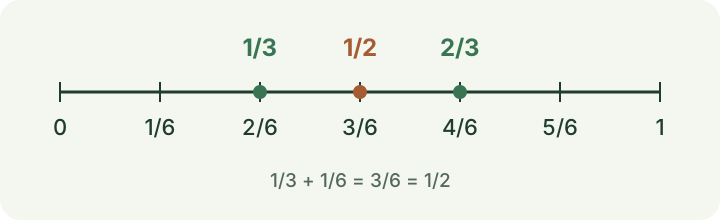
Draw a line from 0 to 1, then divide the distance into six equal intervals. There are seven tick marks including the endpoints, but six spaces. Each space represents one sixth of the whole. Ask which tick is one step after zero, then which is two steps after zero. This checks that the fraction is being connected to a distance rather than just to a label.
Give the same point two names
Mark 2/6 and call the same point 1/3. Two of the six equal spaces cover the same distance as one of three equal spaces. Next, mark 3/6 and name it 1/2. The point has not moved; only the partition used to describe it has changed. Ask the learner to explain 4/6 = 2/3 by grouping the sixths into pairs.
| Position in sixths | Another name | What to notice |
|---|---|---|
| 2/6 | 1/3 | Two sixths make one third of the same whole. |
| 3/6 | 1/2 | Three sixths reach the midpoint. |
| 4/6 | 2/3 | Four sixths make two thirds. |
Compare before calculating
Now compare 1/3 and 1/2. On this line, 1/3 is at 2/6 and 1/2 is at 3/6, so 1/3 < 1/2. Ask for a second comparison using 2/3. It is to the right of 1/2 and therefore greater. Keep both fractions on the same scale: separate lines with different endpoints would make a visual comparison harder to interpret.
Comparing fractionsChoose a short comparison sheet after the marked positions make sense.Make one short calculation
- 1
Start at one third
Use the point 1/3 = 2/6. State the starting value before drawing a jump.
- 2
Move forward one sixth
Move one equal interval to the right. Two sixths plus one sixth reaches three sixths.
- 3
Name and check the result
Write 1/3 + 1/6 = 2/6 + 1/6 = 3/6 = 1/2. The answer is greater than 1/3 and less than 1, which agrees with the picture.
Choose the next sheet from the explanation
If the learner counts tick marks instead of spaces, stay with placing fractions on the line. If they can locate the points but struggle to give one point two names, try equivalent fractions next. Once the comparisons make sense, ask for another addition using the same line: 1/2 + 1/6 = 2/3. Let the explanation guide your next choice.